

Distraction techniques for dementia caregivers can help redirect a person’s attention when they are agitated, restless, repetitive, confused, or focused on something upsetting. Effective options include familiar music, simple household tasks, family photographs, favorite drinks or snacks, sensory activities, walks, and conversations about familiar interests.
Before trying to distract someone with dementia, check whether an unmet need may be causing the behavior. Pain, hunger, thirst, fatigue, toileting needs, fear, boredom, or too much noise can all contribute to distress. Start by acknowledging the person’s feelings, use calm and simple language, and offer one familiar activity rather than arguing, correcting, or forcing them.
The most effective approach depends on the individual and the situation. If distraction does not work, reduce stimulation, give the person space, and look for patterns or triggers. Sudden or severe changes in behavior should not automatically be treated as dementia-related and may require medical attention. When dementia care becomes difficult to manage alone, additional in-home support can give both the person and caregiver more consistent help.
These techniques can help in the moment, but dementia caregiving can still be demanding. Families in Massachusetts and other CareMatch at Home service areas can also consider professional in-home care for companionship, daily support, and relief for family caregivers.
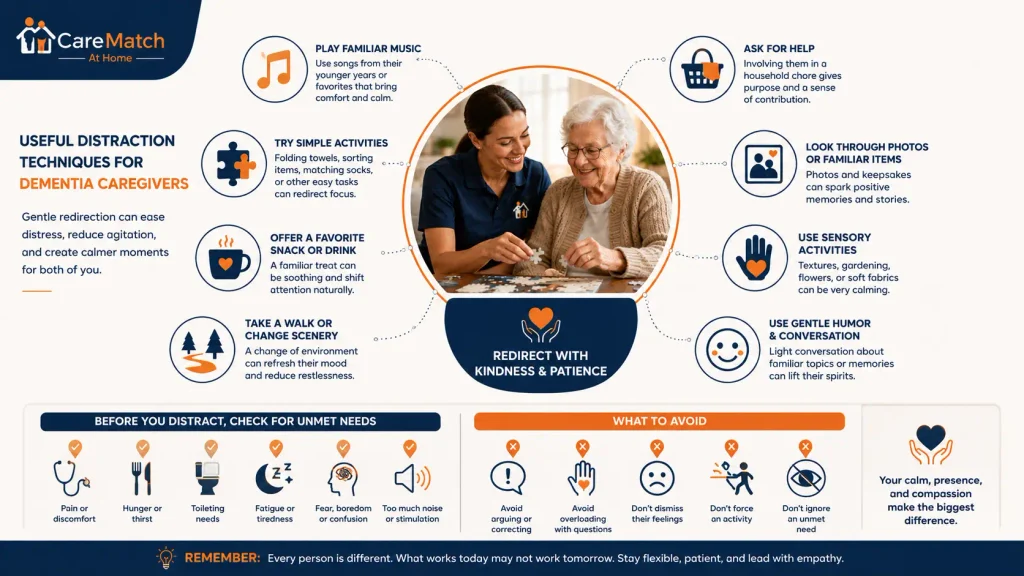
What Distraction Means In Dementia Care
Distraction in dementia care means gently shifting a person’s attention from something causing distress toward a familiar, calming, or meaningful activity. It is often better understood as redirection because the goal is not to ignore the person’s feelings. The goal is to help them move toward something more comfortable.
Distraction Vs. Redirection: What’s The Difference?
The words are often used interchangeably, but redirection gives caregivers a better way to think about the process. Suppose someone repeatedly says, “I need to go home.”
Telling them, “This is your home. You are already here,” may seem logical, but it may not resolve the emotion behind the statement. A more helpful response might be:
“You miss home. Let’s sit down and have some tea.”
You have acknowledged the feeling and then offered a new focus.
That distinction matters. A person with dementia may not be able to process a long explanation or remember the explanation a few minutes later. The Alzheimer’s Association recommends looking for the reason behind repetitive behavior and focusing on the emotion rather than simply reacting to the behavior.
Why Reasoning And Correcting Often Do Not Work
Dementia can affect memory, attention, language, and the ability to process new information. A person may genuinely believe something that is incorrect from your perspective. Repeatedly correcting them can turn a manageable moment into an argument.
This does not mean caregivers should agree with every statement. It means the immediate priority is often reducing distress rather than winning an argument. A calm voice, simple language, patience, and reassurance can make communication easier.
When Gentle Redirection Can Help
Redirection may be useful when someone is:
Becoming agitated
Repeating a question or activity
Restless or pacing
Focused on something upsetting
Bored or under-stimulated
Struggling with a particular care task
Becoming overwhelmed by the environment
It should not become an automatic response to every behavior. First consider what the person may be trying to communicate.
Before Trying To Distract Someone With Dementia
A distraction can fail because the activity is wrong. It can also fail because the person does not need distraction in the first place. Agitation often has a reason. Pain, lack of sleep, constipation, medication effects, environmental changes, noise, loneliness, and feeling pressured can all contribute to distress.
Check For Pain, Hunger, Thirst, Or Toileting Needs
Before reaching for an activity, check the basics.
Ask yourself:
- Could they be hungry or thirsty?
- Do they need to use the bathroom?
- Are they uncomfortable?
- Are they tired?
- Could they be in pain?
- Have they recently taken medication or started a new medicine?
If the underlying problem remains, distraction may only postpone it.
Look For Fatigue, Boredom, Fear, Or Confusion
Behavior can also change when a person feels bored, lonely, frightened, confused, or tired. Someone pacing around the house may need movement rather than a television program.
Someone repeatedly asking about a family member may need reassurance. Someone refusing to get dressed may be uncomfortable with the task, the environment, or the way it is being approached. The behavior is not always the whole story.
Reduce Noise, Crowding, And Other Environmental Triggers
Too much stimulation can make things harder. Turn down the television. Reduce background conversations. Move away from a crowded room. Give the person more time to process what you are saying.
People with dementia may have difficulty following conversations or filtering background sounds, so a quieter environment can make communication easier. (NIA)
Consider Whether The Person Is Trying To Communicate A Need
A repeated question or unusual behavior may be an attempt to communicate something. For example, repeated requests to go home could reflect fear, loneliness, discomfort, or a desire for something familiar.
Instead of asking only, “How do I stop this behavior?” try asking: “What might this behavior be telling me?” That question can completely change how you respond.

How To Redirect Someone With Dementia Without Causing More Distress
Good redirection is usually gentle, simple, and flexible. The person should not feel as though they are being controlled or tricked into stopping a behavior.
Acknowledge Their Feelings Before Changing The Subject
Start with the emotion. If they seem worried, acknowledge that worry. If they are frustrated, recognize their frustration. If they say they want to go somewhere, you might say:
“You really want to go there. I understand.”
Then offer another focus:
“Let’s have a drink first. Would you like tea or water?”
This approach respects the person instead of immediately correcting them.
Stay Calm And Use Simple, Reassuring Language
Your tone matters. Speak slowly. Keep your sentences short. Give the person enough time to respond. Avoid asking several questions at once. If they do not understand, try saying the same thing in simpler words.
The National Institute on Aging recommends patience, a warm manner, and simple communication when speaking with someone who has Alzheimer’s disease.
Offer One Familiar Activity Or Choice At A Time
Too many choices can create another source of stress.
Instead of:
“Do you want to watch television, listen to music, go outside, look at photographs, do a puzzle, or help me cook?”
Try:
“Would you like to listen to your music?”
If they say no, try something else.
Follow Their Response And Do Not Force The Activity
Not every distraction will work every time. A favorite song may calm someone on Monday and annoy them on Tuesday. An activity that worked during the morning may be too tiring in the evening. Watch their body language and mood. If they become more distressed, stop and reassess.
Useful Distraction Techniques For Dementia Caregivers
The best distraction techniques are usually familiar, simple, and connected to the person’s interests or past routines.
Play Familiar Music They Enjoy
Music can provide a familiar point of focus without requiring complex conversation. Try music connected to the person’s younger years, favorite singer, cultural background, religious traditions, or regular routines. Keep the volume comfortable and watch the person’s reaction.
The National Institute on Aging includes music among approaches that can help create a more comforting environment and recommends focusing on familiar activities when someone becomes agitated.
Give Them A Simple Familiar Task
An activity does not need to look like a formal “dementia activity.” It can be something ordinary.
Ask them to:
- Match socks
- Fold towels
- Sort utensils
- Water plants
- Wipe a table
- Organize photographs
- Put napkins on the table
The task should match their current abilities.
The Alzheimer’s Association notes that familiar activities can be modified to suit a person’s abilities, and meaningful engagement may help reduce behaviors such as wandering or agitation.
Ask For Help With A Household Chore
Asking for help can sometimes feel more natural than telling someone they need an activity.
Instead of:
“You need something to do.”
Try:
“Could you help me fold these towels?”
This gives the person a purpose and a clear task. It also creates a natural transition away from whatever was causing frustration.
Look Through Family Photos Or Familiar Objects
Familiar objects can create a comfortable conversation. Look through an old photo album. Talk about a familiar place. Hold an object connected to a hobby or former occupation. Do not turn the moment into a memory test.
Avoid questions such as:
“Do you remember who this is?”
Instead, simply make observations:
“This looks like the garden you used to love.”
The goal is connection, not testing memory.
Offer A Favorite Drink Or Snack
Sometimes a simple physical need provides an easy opportunity for redirection. Offer a familiar drink or snack when appropriate. You might say:
“Let’s sit down and have some tea.”
The activity combines movement away from the stressful situation with something familiar. Of course, always consider dietary restrictions, swallowing difficulties, allergies, and other individual care needs.
Try Sensory Activities And Familiar Textures
Some people respond well to simple sensory experiences.
Depending on the person’s abilities and preferences, this might include:
- Folding soft fabrics
- Handling safe household objects
- Gardening
- Kneading dough
- Looking at flowers
- Listening to calming sounds
The activity should be safe and supervised when necessary.
Take A Walk Or Change Rooms
A change of environment can sometimes interrupt a cycle of agitation or repetitive behavior. A short walk around the home, sitting in another room, stepping into a garden, or looking outside a window may provide a new focus. Physical activity and outdoor time can also be incorporated into routines for people living with dementia.
Talk About Familiar Memories And Interests
Reminiscence can give someone a comfortable subject to focus on.
Talk about:
- Favorite music
- Former hobbies
- Pets
- Gardening
- Cooking
- Sports
- Family traditions
- Places they enjoyed visiting
Do not pressure them to remember specific dates or names. The conversation should feel like companionship, not an examination.
Use Gentle Humor When It Is Appropriate
Humor can sometimes shift the emotional tone of a difficult moment. But know the person. A joke that feels warm and familiar to one person may feel confusing or dismissive to another. If they are frightened or highly distressed, reassurance may be more appropriate than humor.

Choosing The Right Distraction For The Situation
There is no single best distraction technique for dementia. The most useful option depends on what is happening and what the person enjoys.
When Someone Is Agitated Or Upset
First reduce stimulation. Use a calm voice. Listen. Reassure them that they are safe. Then offer something familiar, such as music, a drink, a favorite television program, or a quiet walk. Do not immediately overwhelm them with questions.
When Someone Repeats The Same Question
Repetition can be frustrating for caregivers, but arguing about it rarely solves the problem. Look for the emotion or need behind the repetition. Answer calmly, then consider turning their attention toward an activity.
For example:
“Yes, we’re having lunch soon. Would you help me set the table?”
The Alzheimer’s Association specifically recommends looking for patterns behind repetition, focusing on emotion, staying calm, and turning repetitive actions into meaningful activities when appropriate.
When Someone Is Restless Or Wants To Leave
Do not assume that the person simply needs to be “distracted.” They may need movement, reassurance, the bathroom, food, companionship, or a change in environment.
If it is safe, a supervised walk or simple physical activity may be more appropriate than asking them to sit still. If there is a risk of wandering or leaving an unsafe area, the priority becomes safety rather than distraction.
When Someone Resists A Care Task
Bathing, dressing, eating, and other daily tasks can become difficult as dementia progresses. Instead of pushing through resistance, consider whether the person is tired, uncomfortable, embarrassed, confused, or overwhelmed. Break the task into smaller steps. A familiar conversation, favorite music, or simple activity may help create a calmer transition.
When Confusion Or Restlessness Gets Worse In The Evening
Some people experience increased confusion, restlessness, or agitation later in the day. This is commonly called sundowning. Keeping a predictable routine, reducing stimulation, maintaining daytime activity, and getting appropriate exposure to daylight can help some people manage late-day difficulties.
If evening behavior suddenly changes or becomes significantly worse, however, do not automatically assume it is sundowning. Consider whether illness, pain, medication changes, or another problem could be contributing.
What To Avoid When Redirecting Someone With Dementia
A distraction technique can become counterproductive when the caregiver focuses only on stopping the behavior.
Do Not Argue, Correct, Or Try To Prove Them Wrong
If someone is convinced of something that is not factually correct, repeatedly proving them wrong may increase distress. You do not need to participate in an argument. Focus on what the person is feeling and what can make the moment safer and calmer.
Do Not Overload Them With Questions Or Instructions
Long explanations can be difficult to follow. Give one instruction at a time.
Instead of:
“Go upstairs, get dressed, brush your teeth, and then come downstairs because we’re leaving soon.”
Try:
“Let’s get dressed.”
Then guide the next step.
Do Not Dismiss Or Ignore Their Feelings
Distraction should not mean:
“Never mind. Look at this.”
The person’s concern may be very real to them. Acknowledge it first.
Do Not Force Physical Contact Or An Activity
Gentle touch can be comforting for some people, but not everyone wants to be touched. The same applies to activities. If someone clearly does not want to participate, pushing harder can increase resistance.
Do Not Use Distraction To Ignore An Unmet Need
This may be the most important warning in the entire article. If someone is in pain, hungry, thirsty, constipated, frightened, ill, or experiencing another physical problem, distraction is not the solution. Find the cause first.
What To Do When Distraction Does Not Work
Sometimes the best technique is the one you decide not to continue.
Try A Different Approach Or Activity
Give the first technique a reasonable chance, then change direction if it is clearly not helping. A person who refuses music may accept a snack. Someone who does not want to talk may enjoy folding towels. Someone who does not want to sit may need to walk.
Give The Person Space And Reduce Stimulation
If an activity makes things worse, remove it. Lower the television volume. Reduce the number of people in the room. Give the person time. Sometimes doing less is more effective than offering another activity.
Look For A Pattern Or Trigger
Keep track of when difficult moments happen.
Ask:
- What happened immediately before?
- What time was it?
- Who was present?
- Was the environment noisy?
- Has the person eaten or slept?
- Was a care task involved?
- What response helped?
- What made things worse?
Patterns can help caregivers understand triggers over time.
Know When To Stop Trying To Redirect
If the person becomes increasingly distressed, threatening, physically aggressive, unusually confused, or unsafe, stop focusing on distraction and consider what additional help is needed. Safety comes first.
When Dementia-Related Distress Needs Professional Attention
Not every behavior change should be treated as a normal part of dementia. A new or rapidly worsening change can sometimes have a medical cause.
Sudden Or Unusual Changes In Behavior
A sudden change in confusion, attention, communication, or behavior deserves medical attention. Sudden confusion can be a sign of delirium, which can have causes that need prompt assessment.
Signs Of Pain, Illness, Or Physical Discomfort
Look for changes that occur alongside:
- Fever
- New pain
- Changes in eating or drinking
- New sleep problems
- Unusual drowsiness
- New difficulty communicating
- Sudden worsening confusion
- Other physical symptoms
Do not assume every new behavior is simply dementia progressing.
Severe Agitation, Aggression, Or Safety Concerns
If someone becomes physically aggressive or there is a risk of harm, create distance and seek appropriate professional help. The National Institute on Aging recommends protecting the person and others during aggressive episodes and speaking with a healthcare provider when aggressive behavior worsens.
When To Contact A Doctor Or Seek Urgent Help
Contact a healthcare professional when behavior changes are sudden, severe, persistent, or difficult to explain. Urgent medical assessment may be necessary for sudden confusion or other signs of a serious medical problem.
Supporting Yourself As A Dementia Caregiver
It is easy to focus so heavily on the person with dementia that the caregiver’s own needs disappear. That is not sustainable.
Recognize When Caregiving Is Becoming Overwhelming
If you are constantly managing agitation, repetitive questions, wandering, personal care, meals, appointments, and household responsibilities, you may eventually reach a point where informal caregiving is no longer enough. That does not mean you have failed. It means the level of care has changed.
Take Breaks And Ask For Additional Support
Respite, family support, community resources, and professional in-home care can give caregivers more room to rest and continue providing consistent support.
Professional help can also be useful when a person needs regular companionship, supervision, assistance with daily activities, or a more consistent caregiving routine.
When In-Home Care Can Help
In-home care can be an option when remaining at home is important but family members cannot provide all the support alone. A professional carer may help with companionship, daily routines, personal care, household tasks, and other non-medical needs depending on the person’s care plan.
For families exploring private home care, a service such as CareMatch at Home can provide a pathway toward finding in-home caregiving support that fits the person’s needs and circumstances.
The goal is not to replace family. It is to give families more support when dementia care becomes difficult to manage alone.
Find The Right Support For Dementia Care At Home
Caring for someone with dementia can bring difficult moments, especially when agitation, repetition, or restlessness becomes part of the daily routine. If you’re finding that these situations are becoming harder to manage alone, CareMatch at Home can help you find trusted non-medical in-home care support tailored to your loved one’s needs.
Our service connects families with vetted, background-checked caregivers, with up to two carefully selected matches to help you find the right fit without the overwhelm. CareMatch at Home serves families across the U.S., including communities in Massachusetts, Texas, Arizona, and other major service areas.
Ready to explore care options for your loved one? Start the free Care Finder and discover matched in-home support for dementia care, companionship, and daily living needs.
Conclusion
The best distraction technique for dementia is not necessarily the most entertaining activity. It is the one that matches the person’s needs, abilities, interests, and emotional state. Music, familiar tasks, photographs, sensory activities, food or drinks, walks, and meaningful conversations can all provide a gentle change of focus.
Remember that redirection should not be used to dismiss someone’s feelings or hide an unmet need. Check for pain, hunger, thirst, fatigue, toileting needs, fear, confusion, or environmental stress first. Then acknowledge the person’s emotions, stay calm, offer one simple choice, and follow their response. Avoid arguing, correcting, overwhelming them with instructions, or forcing an activity that increases distress.
If agitation or confusion is sudden, severe, or accompanied by other concerning changes, speak with a healthcare professional rather than relying on distraction alone. And if managing dementia care is becoming overwhelming, asking for additional in-home support can help. The goal is not simply to stop difficult behavior. It is to understand what the person needs and help them feel safer, calmer, and more supported.
Frequently Asked Questions About Distraction Techniques For Dementia
What Are The Best Distraction Techniques For Dementia Caregivers?
The best techniques are usually familiar and meaningful to the individual. Music, simple household tasks, photographs, favorite foods or drinks, walks, sensory activities, and familiar hobbies can all provide a new focus. The right choice depends on the person’s interests, abilities, mood, and the reason behind the behavior.
How Do You Calm An Agitated Person With Dementia?
Start by staying calm and looking for a possible cause. Check for pain, hunger, thirst, fatigue, toileting needs, environmental stress, or another unmet need. Acknowledge the person’s feelings, reduce stimulation, and then offer a familiar activity or change of environment. Avoid arguing or trying to force the person to accept your explanation.
What Activities Can Distract Someone With Dementia?
Useful activities include listening to familiar music, folding laundry, looking through photographs, gardening, reading, taking a walk, watching a favorite program, preparing a simple snack, or handling familiar objects. Activities should be adapted to the person’s current abilities rather than based only on what they enjoyed before dementia.
Does Music Help With Dementia Agitation?
Music can be a useful calming or redirecting activity for some people, especially when it is familiar and personally meaningful. Keep the volume comfortable and observe the person’s response. Music should not be treated as a guaranteed solution because preferences vary from person to person.
How Do You Redirect Someone With Dementia Who Keeps Asking The Same Question?
First consider why they are repeating the question. They may be anxious or trying to communicate a need. Answer calmly, avoid arguing, and acknowledge the emotion. You can then redirect toward a familiar activity, such as setting the table, looking at photos, listening to music, or having a drink.
What Should You Do If Someone With Dementia Refuses To Be Distracted?
Do not force the activity. Stop, reduce stimulation, and reassess what may be causing the distress. Try again later with a different approach if appropriate. Refusal may be meaningful information about discomfort, fear, fatigue, or simply not wanting to participate.
Why Should You Not Argue With Someone Who Has Dementia?
Arguing may increase frustration without resolving the underlying belief or concern. Dementia can affect memory, language, reasoning, and the ability to process information. A calmer approach is to acknowledge the person’s feelings, reassure them, and redirect when appropriate.