

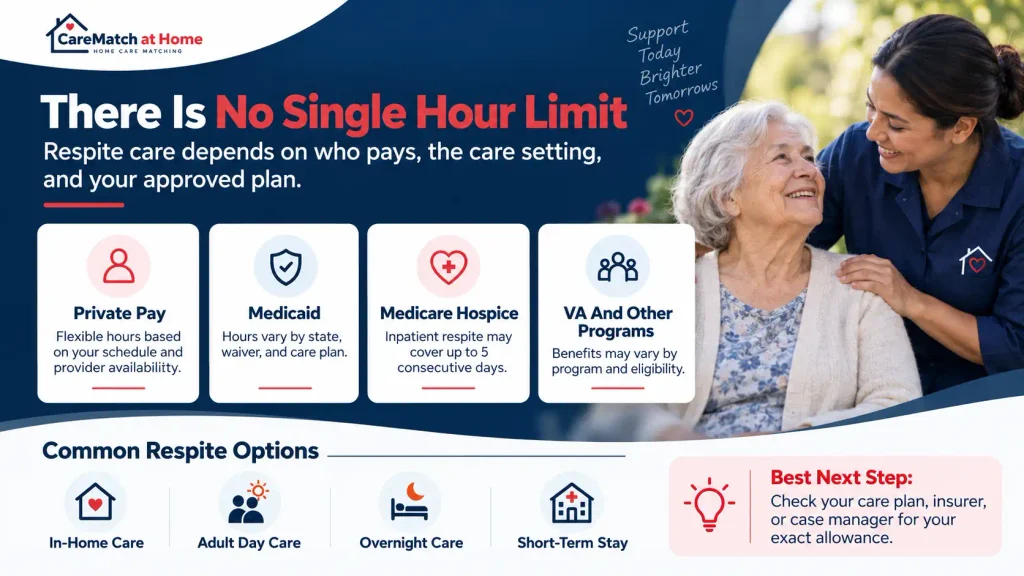
There is no universal limit on how many hours of respite care you are allowed. Respite care may last a few hours, a full day, overnight, or several days. Your actual allowance depends on who pays for the care, the type of respite service, your care needs, your state, and the rules of the program you use.
For families nationwide, CareMatch at Home helps connect people with in-home care options that can provide flexible support when a regular caregiver needs time away. If you pay privately, you may have more freedom to arrange respite care around your schedule and provider availability. Medicaid respite care varies by state and program, while Medicare follows separate rules. For eligible hospice patients, Medicare may cover inpatient respite care for up to five days at a time.
So, if you are wondering how many respite care hours you can get per day, week, or month, there is no single number that applies to everyone. Your exact limit may be measured in hours, service units, days, or an approved budget. This guide explains how Medicare, Medicaid, private-pay care, Veterans benefits, and different respite settings can affect the amount of care available to you.
What Determines How Many Respite Care Hours You Can Get?
Several factors can affect the amount of respite care available. Two families with similar caregiving needs may receive different amounts because they live in different states, use different programs, or have different care plans.
Who Pays for the Respite Care
The funding source is often the biggest factor. Private-pay families generally arrange care directly with an agency, caregiver, adult day program, or residential provider. Public programs such as Medicaid, Medicare, and certain Veterans Affairs programs have their own eligibility and service rules. Long-term care insurance may also provide respite benefits, but coverage depends on the individual policy.
Your Loved One’s Care Needs
Some public programs assess the person receiving care before approving services. The assessment may look at mobility, supervision needs, daily activities, medical conditions, cognitive needs, and the amount of help already provided by family members.
A person who needs constant supervision may qualify for a different level of support than someone who only needs occasional companionship. An assessment does not guarantee a specific number of hours. It helps the program decide what services may be appropriate under its rules.
State and Program Rules
Respite care programs are not identical across the United States. Medicaid is a good example. States can use Home and Community-Based Services programs to provide services such as personal care, adult day health services, home health support, and respite care. States can also establish eligibility criteria for their waiver populations.
As a result, a respite allowance available in one state may not match the allowance available somewhere else.
The Type of Respite Care You Choose
Respite care does not always come in hourly blocks. Some families need an in-home caregiver for three or four hours. Others need a full day at an adult day program. A caregiver traveling for several days may need overnight or residential respite care. The care setting can change how services are measured, scheduled, and paid for.
Respite Care Limits by Funding Source
The simplest way to understand respite limits is to look at the source paying for the service.
| Funding Source | How Respite Limits Generally Work |
| Private pay | Usually based on family needs, provider availability, scheduling rules, and budget |
| Medicaid | Varies by state, waiver, eligibility, assessment, and approved service plan |
| Medicare | Limited respite benefit for eligible hospice patients, generally up to five days at a time |
| VA benefits | Eligible Veterans may have access to respite benefits based on VA program rules |
| Long-term care insurance | Depends on the individual policy and benefit terms |
| Community programs | Hours and availability depend on the specific state, local, or nonprofit program |
The table shows why there is no reliable universal answer such as “20 hours per week.” The correct number depends on the program being used.

How Many Hours of Respite Care Can You Get Through Medicaid?
Medicaid can cover respite care through certain Home and Community-Based Services programs, but there is no single national Medicaid respite-hour limit. Federal Medicaid rules allow states to design HCBS waiver programs for specific groups and offer services that can include respite care. States can also set program eligibility requirements and service structures.
Because states manage these programs differently, one Medicaid waiver may authorize respite in hours while another may use different service units or limits.
How Medicaid HCBS Waivers Affect Respite Hours
Home and Community-Based Services waivers are designed to help eligible people receive support in their homes and communities rather than only in institutional settings.
Respite care may be one part of a larger care plan. Other covered supports can include personal care, case management, adult day health services, homemaker services, and home health assistance. The presence of respite care in a waiver does not mean every participant automatically receives the same amount.
Why Medicaid Limits Vary by State
States can design waiver programs for different populations. One program may serve older adults, while another may focus on people with developmental disabilities, brain injuries, or other qualifying needs.
Each program can have its own service definitions, eligibility rules, and authorization process. That is why searching for a national number of “Medicaid respite hours per week” can be misleading.
How Your Care Assessment Can Affect Approved Hours
If you apply for a Medicaid-funded program, an assessment may help determine the services included in your care plan.
Be clear about the caregiver’s responsibilities and the care recipient’s needs. Explain supervision needs, help with daily activities, safety concerns, nighttime needs, and the amount of unpaid care already being provided. Your case manager or care coordinator can then explain how respite is authorized under that specific program.
How Many Days of Respite Care Does Medicare Cover?
Medicare’s respite benefit is more specific. Medicare Part A can cover inpatient respite care for eligible people receiving hospice care. The hospice provider arranges the stay in an approved facility when a usual caregiver needs a break.
The 2026 Medicare handbook states that a person can stay up to five days each time inpatient respite care is provided. Medicare guidance also says respite can be used more than once, although it is intended for occasional use. This is one of the most important distinctions in this topic. Medicare does not simply provide every older adult with a set number of general respite-care hours.
Who Qualifies for Medicare Hospice Respite Care
The person must qualify for Medicare hospice coverage. Medicare states that the individual must have Part A and meet hospice eligibility requirements. This includes certification of a terminal illness and choosing comfort-focused hospice care for that terminal condition. The hospice care team determines when short-term inpatient respite care is appropriate and arranges the service.
Where Medicare-Covered Respite Care Can Be Provided
Medicare’s hospice respite benefit applies to inpatient respite arranged by the hospice provider. It is different from simply hiring someone privately to stay in the home while a family caregiver goes out for several hours. The Medicare hospice provider must arrange the covered inpatient respite stay in an appropriate approved setting.
How Often Medicare Respite Care Can Be Used
Medicare guidance allows hospice respite care more than once, but describes it as an occasional benefit. Families should speak directly with the hospice team when another respite period is needed. For covered inpatient respite care, Medicare beneficiaries may pay 5% of the Medicare-approved amount.
Veterans Respite Care Benefits
Eligible Veterans and their caregivers may also have access to respite services through the Department of Veterans Affairs. Current VA information states that respite services may be available for up to 30 days in a calendar year under certain VA respite programs. Care may take place at home or in a facility depending on the service and local availability.
The VA also states that eligible primary family caregivers participating in the Program of Comprehensive Assistance for Family Caregivers can receive access to at least 30 days of respite care each year. Eligibility, scheduling, available care settings, and possible costs should be confirmed with the Veteran’s VA care team or social worker.
What About Long-Term Care Insurance?
Some long-term care insurance policies include benefits that may help pay for respite care. However, there is no universal allowance across all policies. One plan might pay for home care after certain eligibility conditions are met. Another may cover adult day care or facility-based care. Limits may be expressed as a daily amount, monthly amount, number of days, or total benefit pool.
Read the policy’s definition of respite care carefully. You should also check the elimination period, covered settings, daily benefit, lifetime benefit, and provider requirements. Do not assume a long-term care insurance policy covers respite care simply because it covers other forms of long-term care.
How Long Can Someone Stay in Respite Care?
A respite stay can range from a few hours to several days depending on the setting and program. Respite is meant to provide temporary relief for the usual caregiver. It is not one single type of care.
In-Home Respite Care
In-home respite is useful when the care recipient feels safest and most comfortable at home. A respite caregiver may stay for a few hours while the family caregiver attends appointments, runs errands, works, rests, or spends time with other family members. Some families schedule in-home respite regularly. Others use it only when needed.
Adult Day Respite Care
Adult day programs usually provide support during daytime hours. The person receiving care may spend part or most of the day at the program while the family caregiver gets a longer break. Programs vary in their schedules and services. Some may operate several days each week, while others may have limited availability.
Overnight Respite Care
Overnight respite can help when a family caregiver needs uninterrupted sleep, has an overnight commitment, or will be away from home. It may be provided at home or through an appropriate residential setting depending on the provider and program. The funding source should always be checked before assuming overnight care is covered.
Short-Term Residential Respite Care
Residential respite may last for several days when a caregiver needs a longer break. This can be useful during travel, caregiver illness, family events, or periods of heavy caregiver strain. The maximum stay depends on the facility and the funding arrangement. Medicare hospice respite is one example where specific federal rules apply.

How Often Can You Use Respite Care?
Respite care may be used occasionally or on a regular schedule. There is no general federal rule saying every family can only use respite once per month or a certain number of times each year.
Weekly or Regularly Scheduled Respite Care
Regular respite can give caregivers predictable time away from their responsibilities. For example, a family might arrange care every Tuesday afternoon or several mornings each month. Whether this schedule is possible depends on the provider, approved benefits, and available funding. A regular schedule can also make planning easier for both the caregiver and care recipient.
Occasional and Emergency Respite Care
Some caregivers only need respite for appointments, travel, special events, or unexpected situations. Availability may be more limited when care is requested on short notice. Planning ahead can make it easier to find a suitable caregiver or respite program.
Using Respite Care More Than Once
Many respite programs allow repeated use. The important issue is whether the family’s approved hours, days, service units, or budget allow it. Medicare hospice respite can also be provided more than once, although Medicare describes the benefit as occasional.
Respite Care Hours by Care Setting
Thinking about respite in terms of the needed break can make choosing a service easier.
A Few Hours of In-Home Support
Short visits may work well for medical appointments, errands, exercise, shopping, or simply having quiet time. Families paying privately may have more freedom to build these visits around their schedules. Some providers may require minimum visit lengths.
Half-Day or Full-Day Programs
Adult day programs can give caregivers several hours of relief without requiring an overnight stay. They may also provide activities, meals, supervision, or other services depending on the program.
Overnight and Weekend Care
Longer breaks may be necessary when caregivers have travel plans, need sleep, attend family events, or need more time to recover. Before arranging overnight or weekend respite, confirm exactly what care is included and whether the funding source will pay for it.
Multi-Day Respite Stays
A multi-day respite stay may be appropriate when the primary caregiver needs a longer period away. Program rules matter most at this level. For example, Medicare’s hospice respite benefit allows eligible patients up to five days per respite stay. VA respite programs can operate under different annual limits.
How to Find Out Exactly How Many Respite Hours You Are Allowed
Do not rely on a general number you find online. Your actual allowance can only be confirmed through the program, insurer, care plan, or provider you use. Start by identifying who pays for the care.
If you receive Medicaid services, contact your case manager or waiver coordinator. If the person is receiving hospice care through Medicare, speak with the hospice team. Veterans and their caregivers can contact their VA care team or social worker. Families with long-term care insurance should review their policy or contact the insurer.
When asking about your benefits, confirm five things:
- How many hours, days, or service units are approved
- Whether there is a weekly, monthly, or yearly maximum
- Which types of respite care are covered
- Whether prior authorization is required
- Whether unused benefits expire or carry forward
These questions are more useful than simply asking whether respite care is “covered.”
What If You Need More Respite Care Hours?
Caregiving needs can change. A few respite hours may have been enough six months ago. They may no longer be enough if the person receiving care now needs more supervision, has greater mobility needs, or needs help during the night.
Request a New Care Needs Assessment
If you receive publicly funded services, ask whether you can request another assessment when the person’s condition or caregiving situation changes.
Provide clear information about what has changed. Do not focus only on the number of hours you want. Explain why additional support is necessary.
Ask Whether Additional Hours Can Be Approved
Some programs may have procedures for changing an existing service plan. Your case manager can explain whether additional hours are available and what documentation may be required. Approval is not guaranteed because program rules and funding limits still apply.
Combine Available Respite Care Resources
One funding source may not meet every caregiving need. Some families combine public benefits, community services, help from relatives, adult day programs, and private-pay care. The goal is to build a realistic schedule that gives the primary caregiver dependable breaks.
Consider Private-Pay Hours When Needed
Private-pay respite can sometimes fill gaps that public programs do not cover. Before choosing a provider, ask about minimum visit lengths, caregiver qualifications, scheduling rules, cancellation policies, overnight availability, and the types of assistance provided.
How to Make the Most of Your Respite Care Hours
Having respite hours available does not always mean caregivers use them effectively. Many family caregivers wait until they feel exhausted before arranging a break. Regular respite can be easier to plan and may help prevent caregiver strain from becoming overwhelming.
Schedule Breaks Before Caregiver Burnout
Respite does not need to be reserved for emergencies. A predictable break can give caregivers time to rest, attend appointments, exercise, work, see friends, or handle responsibilities outside caregiving. Using support earlier can also make respite feel like a normal part of the care plan rather than a last resort.
Use Longer Breaks for Important Responsibilities
A one-hour break may not be useful if the caregiver needs to travel to an appointment across town. Think about what you need to accomplish, then choose a respite period that gives you enough time without feeling rushed.
Plan Care Around the Care Recipient’s Routine
A familiar routine can make the transition easier for the person receiving care.Share important details about meals, medication routines, mobility assistance, communication preferences, activities, and safety needs with the respite provider. Good preparation helps everyone use the available time more effectively.
Frequently Asked Questions
How Many Hours of Respite Care Can You Get Per Week?
There is no universal weekly limit. Your allowance depends on your funding source, state program, care plan, insurance policy, or private arrangement. Medicaid-funded respite is especially variable because states design and administer their own HCBS programs.
Can You Use Respite Care Every Day?
It may be possible if your care arrangement and funding allow it. Private-pay care can often be scheduled more flexibly. Publicly funded programs may limit the number of approved hours or service units, so check your individual plan.
Can Respite Care Be Used Overnight?
Yes. Overnight respite is available through some home care providers, residential programs, hospice arrangements, and Veterans programs. Coverage and eligibility vary, so confirm the rules before scheduling care.
Can You Get Respite Care for a Weekend?
Some respite providers and residential programs offer weekend care. Whether it is covered depends on the program paying for the service. Private-pay families may also arrange weekend care directly when providers have availability.
Do Unused Respite Care Hours Roll Over?
Not always. Some programs may use weekly, monthly, annual, or authorization-period limits. Unused hours may expire under certain programs. Ask your case manager, insurer, or provider specifically whether unused benefits can be carried forward.
Can You Get More Respite Hours if Your Needs Change?
Possibly. Some programs allow reassessment when the care recipient’s needs or caregiver situation changes. Contact the program managing your benefits and ask whether your service plan can be reviewed.
Is There a Legal Maximum for Respite Care Hours?
There is no single nationwide maximum that applies to every type of respite care. Individual public programs, insurance plans, state programs, and care providers can have their own limits.
Can Family Caregivers Receive Respite Care Regularly?
Yes. Regular respite may be available through private care, adult day programs, Medicaid programs, VA services, and community resources. Eligibility and the amount available depend on the specific program.
Does Insurance Pay for All Respite Care Hours?
Not necessarily. Coverage varies widely. Medicare covers specific inpatient respite care for eligible hospice patients rather than unlimited general respite care. Medicaid and long-term care insurance have different rules.
What Happens When Your Respite Care Hours Run Out?
Ask whether additional services can be authorized, whether another respite program is available, or whether private-pay support can fill the gap. If caregiving needs have increased, you may also want to request a reassessment of the current care plan.
Find Respite Care Support Nationwide
Need dependable respite care for a loved one? CareMatch at Home helps families nationwide connect with vetted, background-checked in-home care options that fit their needs and schedule. Whether you need a few hours of support, occasional relief, or more regular help, you can start with the free Care Finder and explore caregiver matches without hidden fees.
Conclusion
The answer to how many hours of respite care are you allowed depends on your specific care arrangement. There is no nationwide rule that gives every caregiver the same number of respite hours per day, week, or month. Some people use respite for only a few hours, while others may need daytime, overnight, weekend, or short-term residential care.
Your funding source usually determines the biggest limits. Medicaid respite benefits vary by state, waiver program, eligibility, and approved care plan. Medicare does not provide unlimited general respite hours. For eligible hospice patients, it can cover inpatient respite care for up to five days each time, with respite available again on an occasional basis. Private-pay care may provide greater scheduling flexibility, while VA and long-term care insurance benefits follow their own program or policy rules.
If you need to know your exact allowance, check whether your benefits are measured by hours, days, service units, or an annual limit. Ask your insurer, Medicaid case manager, hospice team, VA care team, or respite provider how often care can be used and whether unused benefits carry over. If your loved one’s needs have increased, also ask whether your current respite authorization can be reassessed. Knowing these details gives you a much clearer answer than relying on one general number online.