
The most important things not to say to someone with dementia are phrases that test their memory, repeatedly correct them, rush them, dismiss their feelings, argue over facts, or make them feel incapable. Common examples include “Do you remember?”, “I just told you that,” “You’re wrong,” “Calm down,” and “Don’t you know who I am?”
At CareMatch Home, families can connect with caregivers for non-medical dementia support at home. Whether day-to-day support comes from a family member, friend, or professional caregiver, the way we communicate can make ordinary interactions feel more respectful and less stressful.
Instead of trying to find the “perfect” words, focus on calm, clear, adult-to-adult communication. Give the person enough time to respond, offer manageable choices, acknowledge feelings, and provide information without turning the conversation into a memory test. Below are 20 things not to say to someone with dementia, why they can make communication harder, and what you can say instead.
Why What You Say to Someone With Dementia Matters
Dementia can affect memory, language, attention, reasoning, orientation, and the ability to process several pieces of information at once. These changes vary by person and may also change as dementia progresses.
A person might forget a conversation that happened five minutes ago but still experience the frustration or embarrassment created by being corrected. Someone may have difficulty finding the right words while still understanding your tone, facial expression, or attitude.
That is why good communication is not simply about transferring accurate information. It is also about maintaining dignity, reducing unnecessary pressure, and giving the person the best opportunity to participate.
The National Institute on Aging recommends giving people with Alzheimer’s additional time to respond, avoiding arguments, not speaking about them as though they are absent, and not asking whether they remember someone or something. The Alzheimer’s Association similarly recommends calm communication, one question at a time, step-by-step directions, and avoiding unnecessary criticism or correction.
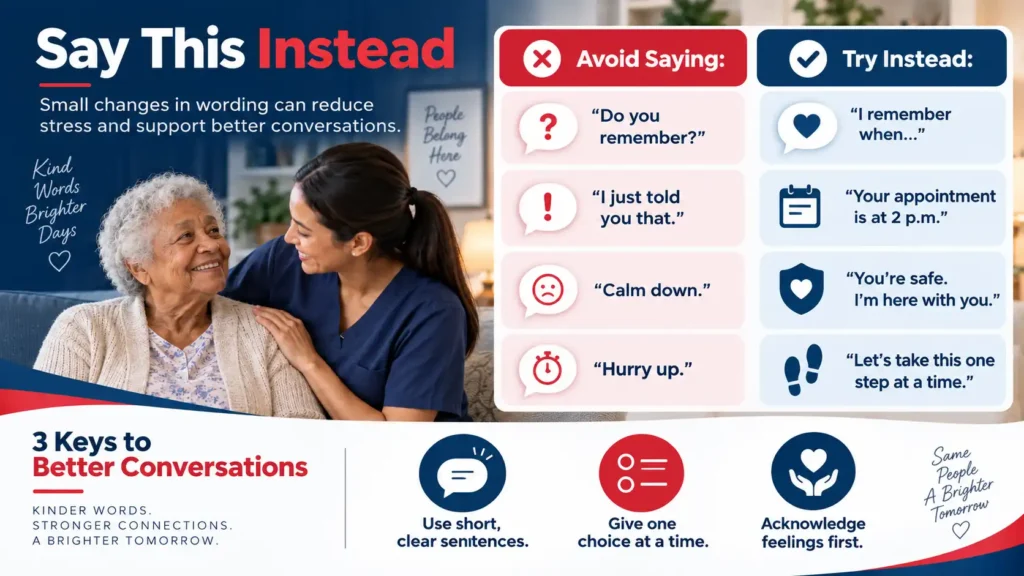
20 Things Not to Say to Someone With Dementia
1. “Do You Remember?”
“Do you remember?” may seem like a natural conversation starter, but it can quickly become a memory test. If the person cannot remember the event, place, or individual you are referring to, they may feel embarrassed or pressured to produce an answer. Instead, provide the information naturally.
Try saying instead:
“I remember when we went to the park together. It was such a nice afternoon.”
This gives the person an opportunity to join the conversation without requiring them to prove that they remember it. The National Institute on Aging specifically advises against asking a person with Alzheimer’s whether they remember something or someone.
2. “I Just Told You That”
Repeated questions can be difficult for caregivers, especially when the same answer has already been given several times. However, the person may genuinely have no memory of asking the question before. Saying “I already told you” usually does not restore that missing memory. It may simply draw attention to the difficulty.
Try saying instead:
“Your appointment is at 2 p.m., and I’ll be going with you.”
If a question keeps coming back, consider what may be behind it. Repetition can sometimes reflect a need for comfort, reassurance, security, or familiarity rather than a need for new information.
3. “You’re Wrong”
Not every incorrect detail needs to become a correction. A person might say they went to work that morning even though they retired years ago. Responding with “No, you didn’t. You haven’t worked there for 15 years” may create confusion or defensiveness without improving the situation.
Try saying instead:
“You worked there for a long time. What did you enjoy about it?”
If the mistaken belief is harmless, listening for the meaning behind the statement can be more useful than proving that it is factually incorrect. Of course, situations involving safety, healthcare, finances, consent, or another important decision may require clear factual information.
4. “Don’t You Know Who I Am?”
Being forgotten by someone you love can be painful. However, asking the person to identify you places the burden back on them. If they cannot remember, they may become embarrassed, anxious, or aware that they have forgotten someone important.
Try saying instead:
“Hi Mom, it’s Sarah. I came to spend some time with you.”
A warm introduction provides the missing information without testing memory. Alzheimer’s Society recommends considering a friendly introduction with your name or relationship when recognition has become difficult.
5. “Your Husband Died Years Ago”
This situation deserves particular sensitivity. A person with dementia may ask for a spouse, parent, sibling, friend, or other loved one who has died. Repeatedly telling them about the death can sometimes cause them to experience the grief as if they are hearing the news for the first time.
Try saying instead:
“You really miss him. Tell me about him.”
There is no universal rule that the truth should always be withheld. The appropriate response depends on the individual, the circumstances, their ability to process the information, and how previous responses have affected them. Alzheimer’s Society advises considering the person’s best interests and avoiding an automatic one-size-fits-all approach to difficult questions about someone who has died.
6. “What Did You Do This Morning?”
There is nothing inherently inappropriate about asking what someone did earlier. The problem comes when the question functions as a test of recent memory. A broad question may force the person to search for information they cannot easily retrieve.
Try saying instead:
“I heard you spent some time outside this morning. Was the weather nice?”
Giving context or a gentle cue can make the conversation easier to enter. The goal is conversation, not checking whether the person can correctly reconstruct their day.
7. “But You Don’t Look Like You Have Dementia”
Dementia does not have one appearance. A person may communicate confidently during one conversation while experiencing significant difficulties with planning, memory, orientation, or other cognitive tasks elsewhere.Saying someone does not “look” like they have dementia may unintentionally minimize what they are experiencing.
Try saying instead:
“Thank you for telling me. Is there anything you’d like me to understand?”
Avoid assumptions based solely on how capable someone appears during a brief interaction.
8. “Why Are You Doing That?”
A person may repeat an action, search through drawers, walk around the house, follow someone from room to room, or behave in a way that is difficult to understand. Asking “Why are you doing that?” assumes they can explain the behavior clearly.
They may not be able to.
Try saying instead:
“You seem like you’re looking for something. Can I help?”
Behavior can sometimes communicate a need that the person cannot easily express in words. They may be uncomfortable, anxious, hungry, tired, looking for something familiar, or trying to complete a task that makes sense from their perspective.
9. “There’s Nothing to Be Upset About”
You may know that there is no immediate danger, but the person’s emotion can still feel completely real to them. Dismissing the concern may make them feel ignored.
Try saying instead:
“You seem worried. I’m here with you.”
Acknowledge the emotion before trying to solve the situation. Alzheimer’s Society advises listening to feelings as well as facts and recognizing that a person’s words or behavior may be communicating an emotional need.
10. “Calm Down!”
Telling someone to “calm down” rarely provides a reason to feel calmer. If the person is already confused, frightened, frustrated, or overwhelmed, a sharp command may increase the tension.
Try saying instead:
“You’re safe. I’m here. We can take our time.”
Your voice, pace, facial expression, posture, and surroundings can matter as much as the sentence itself. Slow the interaction down and reduce unnecessary stimulation where possible.

11. “Hurry Up”
Dementia can make it harder to process information, organize actions, choose clothing, complete a familiar task, or respond quickly. Repeatedly telling someone to hurry may create pressure exactly when they need more time.
Try saying instead:
“We’re getting ready to go. Let’s put your shoes on first.”
Whenever possible, build additional time into routines rather than expecting the person to match someone else’s pace. Both the National Institute on Aging and dementia organizations emphasize allowing extra processing and response time.
12. “You Can’t Do That”
Dementia can change what someone can manage safely, but it does not mean they automatically lose every ability. Constantly focusing on what the person cannot do can take away independence unnecessarily.
Try saying instead:
“Let’s see if we can do it together.”
Perhaps someone can still fold towels even if managing the entire laundry process is difficult. They may be able to choose between two shirts even if dressing requires assistance. Support should adapt to the person’s current abilities rather than automatically taking over.
13. “I’ll Do It for You”
Helping is important. Taking over before help is needed is different. Immediately completing a task for someone can reduce opportunities to participate in everyday activities they may still be able to perform.
Try saying instead:
“Would you like some help?”
Then give the person enough time to respond or attempt the task. The goal is not to force independence when assistance is genuinely needed. It is to avoid removing independence sooner than necessary. The supportive-care literature on dementia emphasizes maximizing function while adapting assistance to the individual.
14. “Don’t Do That!”
Sometimes an immediate “stop” is necessary for safety. But in ordinary situations, repeatedly saying what someone should not do may give little guidance about what they should do next.
Try saying instead:
“Let’s put this over here.”
Or:
“Come sit with me for a minute.”
Clear redirection can be easier to understand than criticism. When there is a genuine safety risk, use direct language. But when possible, tell the person what they can do rather than focusing only on the unwanted action.
15. “Go Down the Hall, Turn Left, and Take the Second Door”
Long instructions require someone to hold several pieces of information in mind at once. That may become difficult with dementia.
Try saying instead:
“The bathroom is this way. Come with me.”
For activities, give one step and allow enough time to complete it before introducing the next. The Alzheimer’s Association recommends clear, step-by-step directions because lengthy requests may become overwhelming.
16. “You’re Acting Like a Child”
Needing help does not make someone a child. Speaking in a childish tone, scolding, exaggerating your voice, or using “baby talk” can feel patronizing and may undermine dignity.
Try saying instead:
“Would you like me to help with your sweater?”
Continue speaking adult to adult.
The National Institute on Aging specifically recommends avoiding “baby talk” or a “baby voice” with people who have Alzheimer’s. Alzheimer’s Society gives similar advice about avoiding language that talks down to the person.
17. “Honey” or “Sweetie” When That Is Not Their Preference
Terms such as “honey,” “sweetie,” or “dear” are not automatically inappropriate. In some relationships they are affectionate and completely natural. The problem is assuming that needing care means someone should now be addressed in a way they never chose.
If someone has always preferred their first name, family title, professional title, or surname, continue respecting that preference whenever possible.
Try using instead:
The name or form of address the person actually prefers. Respectful communication should remain personal rather than becoming generic.
18. “They Don’t Understand Anyway”
Do not assume that difficulty speaking means a person cannot hear, understand, feel, or participate. Talking about someone’s behavior, care, health, toileting needs, or difficulties directly in front of them as though they are absent can be disrespectful.
Try saying instead:
“Mary, how have you been feeling today?”
Give the person an opportunity to answer before speaking on their behalf. Both NIA and Alzheimer’s Society advise including the person in conversations and avoiding talking about them as though they are not present.
19. “They’re a Wanderer,” “Demented,” or “A Victim”
A behavior or diagnosis should not become the person’s identity. Someone may become disoriented while walking, but calling them “a wanderer” reduces a complex individual to one behavior.
Instead, describe what is actually happening.
Try saying instead:
“John sometimes walks outside and becomes disoriented.”
That communicates useful information without replacing the person with a label. They remain a parent, partner, friend, neighbor, teacher, veteran, artist, gardener, sports fan, or whatever else has shaped their identity.
20. “What Do You Want to Eat, Wear, and Do Today?”
Choice supports independence, but too many decisions presented at once can become overwhelming. Open-ended questions may also require the person to generate and compare several possibilities.
Try saying instead:
“Would you like soup or a sandwich?”
Or:
“Would you like the blue shirt or the green one?” Alzheimer’s communication guidance recommends limiting complicated questions, offering manageable options, and asking one question at a time. NIA gives similar guidance for offering simple choices instead of broad open-ended questions.

What Should You Say Instead to Someone With Dementia?
You do not need to memorize 20 replacement scripts. A few principles can improve many conversations. Use short, clear sentences without making your voice childish. Give one piece of information at a time and allow enough time for the person to process what you said.
When possible, replace memory tests with information. Instead of “Do you remember Susan?”, try “Susan, your neighbor from across the street, is coming over.” Replace arguments with curiosity. If the person says something that does not match the facts, ask yourself whether correcting it is necessary.
Replace pressure with reassurance. Instead of “Hurry up,” break the task into one manageable step. And listen beyond the literal words. Repeated questions, requests to “go home,” or searching for someone may express anxiety, loneliness, confusion, discomfort, or a need for familiarity.
Alzheimer’s Society recommends reducing distractions, speaking clearly, allowing additional response time, avoiding excessive questioning, and paying attention to nonverbal communication such as facial expressions, gestures, and body language.
A sudden or significant change in confusion, behavior, eating, balance, sleep, or physical health should not automatically be assumed to be “just dementia.” Families should discuss concerning changes with the person’s healthcare provider.
What Dementia-Care Research Says About Person-Centered Support
The academic source identified during research for this article, Practical Dementia Care by Peter V. Rabins, Constantine G. Lyketsos, and Cynthia D. Steele, is published by Oxford University Press. A later edition includes dedicated chapters on supportive care and support for families and caregivers.
Its supportive-care discussion emphasizes recognizing the uniqueness of each individual, establishing a relationship with the person, maximizing remaining function, attending to safety, and adapting the environment to the individual’s needs. Communication is specifically identified as part of supportive dementia care.
That principle is useful here because dementia communication should not become a rigid list of “correct” and “incorrect” phrases. What works for one person may not work for another.
The better question is often:
Does the way I am speaking help this particular person feel respected, involved, safe, and understood?
Frequently Asked Questions
Should You Correct Someone With Dementia When They Are Wrong?
Not always. If the mistake is harmless, correcting it may cause frustration. Focus on the person’s feelings instead. Correct information when safety, medical care, finances, consent, or another important issue is involved.
What Should You Say When They Ask for Someone Who Has Died?
There is no single response for everyone. If repeating the death causes distress, acknowledge the feeling instead: “You really miss him. Tell me about him.” Use the response that best fits the person and situation.
What Should You Do When They Repeat the Same Question?
Answer calmly and consider what they may really need. Repetition can reflect anxiety or a need for reassurance. Simple reminders, calendars, clocks, or written notes may also help.
What Are Good Things to Talk About?
Use familiar, comfortable topics such as music, pets, family photos, hobbies, favorite foods, past work, or familiar places. Avoid turning the conversation into a memory test.
How Do You Calm Someone Without Saying “Calm Down”?
Speak slowly, lower your voice, reduce distractions, and acknowledge their feelings. Try: “You look worried. I’m here with you.”
Should You Always Tell Someone With Dementia the Truth?
Truthfulness matters, but bluntly repeating distressing information is not always helpful. Consider what the person can understand, why they are asking, and whether the information is necessary.
What Questions Should You Avoid Asking?
Avoid memory-testing questions, several questions at once, complicated choices, and questions requiring long explanations. Keep questions simple and offer one or two clear options.
Find the Right Dementia Care Support at Home
As dementia care needs change, families may need help with more than communication alone. Daily routines, companionship, personal care, supervision, meals, transportation, and periods of confusion can all become harder to manage.
CareMatch at Home helps families connect with vetted, background-checked caregivers for non-medical dementia care across Massachusetts, Arizona, Texas, California, and Illinois. Share your loved one’s needs, schedule, and location, and CareMatch can help you explore suitable caregiver matches while keeping the person’s routines, preferences, independence, and dignity at the center of care.