

Learning how to deal with a parent with dementia starts with changing how you respond to memory loss, confusion, anger, repeated questions, and resistance to care. Stay calm, use simple language, avoid unnecessary arguments, keep routines familiar, and look for possible triggers behind difficult behavior.
If your parent becomes angry or refuses help, give them time and space rather than forcing the situation when it is safe to wait. Focus on safety, comfort, and dignity. Make daily tasks easier, reduce hazards at home, support activities they can still enjoy, and preserve independence where it remains safe.
As dementia progresses, your parent may need more help with meals, bathing, supervision, transportation, personal care, or staying safely at home. Families in Phoenix, Boston, Dallas, and other communities served by CareMatch at Home can explore non-medical in-home support when everyday care becomes difficult to manage alone. Healthcare professionals should remain involved when sudden behavioral changes, medical concerns, or other health issues arise.
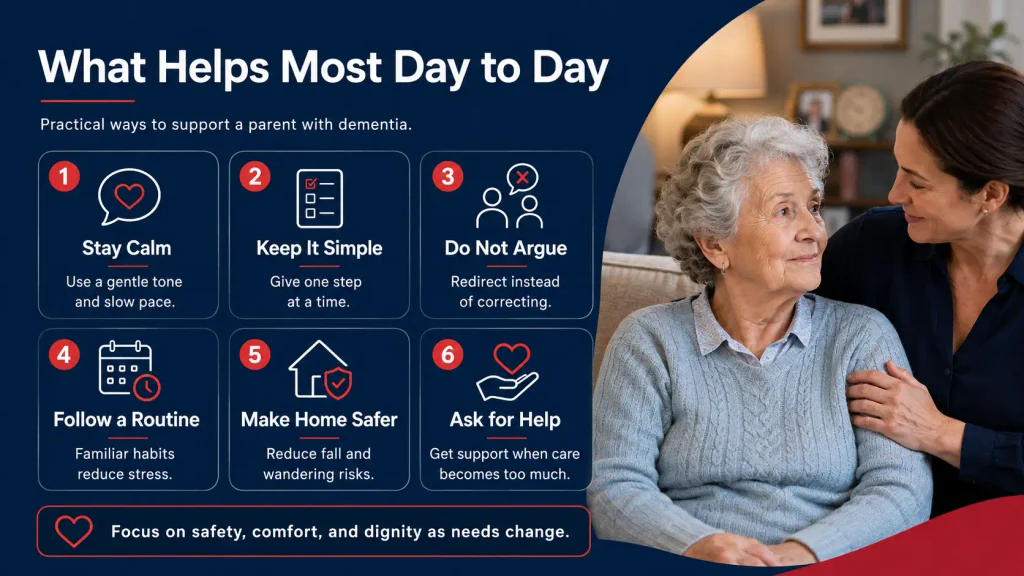
What to Do When Your Parent Has Dementia
One of the most useful shifts is to stop expecting your parent to respond exactly as they did before dementia. Memory, judgment, language, attention, and the ability to complete everyday tasks may change. What looks like stubbornness can sometimes be confusion, fear, embarrassment, pain, or difficulty understanding what is being asked.
Your role is not to correct every mistake. It is to help your parent move through the day as safely and comfortably as possible while preserving as much independence as they can reasonably manage.
Understand How Dementia May Affect Their Daily Life
Dementia can affect much more than remembering names or appointments. Your parent may have trouble following conversations, organizing tasks, making decisions, managing money, recognizing places, or completing routines that once required little thought.
Changes may also appear in mood and behaviour. Anxiety, suspicion, frustration, pacing, sleep problems, or withdrawal can occur. The National Institute on Aging notes that behaviour changes can also be influenced by pain, hunger, thirst, lack of sleep, medication effects, or an overstimulating environment. Try to judge what your parent can manage today, rather than what they could manage six months ago.
Focus on Safety, Routine, and Dignity
A useful caregiving decision can often be tested against three questions. Does this keep my parent safe? Does it make the situation easier to understand? Does it preserve their dignity?
For example, helping with dressing does not always mean dressing your parent completely. You might lay out two appropriate outfits and allow them to choose. During early stages, allowing someone to continue doing tasks they can safely perform can support independence and confidence.
Learn What You Can and Cannot Control
You can change how you communicate, reduce household stress, establish routines, and arrange more support. You cannot reason someone out of every symptom of dementia.
Repeatedly trying to prove that your parent is mistaken may leave both of you frustrated. When the factual detail does not affect safety, responding to the emotion behind the statement is often more productive than winning the argument.
How to Communicate With a Parent Who Has Dementia
Good communication becomes especially important as dementia progresses. Your parent may need more time to understand what you are saying, find the right words, or decide how to respond.
The National Institute on Aging recommends making eye contact, allowing more response time, watching your tone and body language, and avoiding talking about the person as though they are not present.
Keep Conversations Simple and Calm
Use short sentences and deal with one idea at a time. Instead of asking several questions at once, give your parent one clear choice. “Would you like the blue shirt or the green shirt?” may be easier than “What do you want to wear today?”
A quiet environment can also help. Turn down the television or move away from several people talking at once when you need your parent to focus.
Give Your Parent Time to Respond
Silence does not necessarily mean your parent did not understand you. Processing language can take longer. Ask the question, wait, and give them time to answer. Repeating the question immediately or finishing every sentence for them may increase frustration. If they do not understand, try different words instead of simply repeating the exact same phrase more loudly.
Avoid Arguing or Repeatedly Correcting Them
Imagine your parent insists that they need to leave for a job they retired from decades ago. Explaining the date, their age, and their retirement repeatedly may not resolve the concern. Try to understand what is underneath it. They may feel responsible for something. They may want somewhere familiar to go. They may simply be restless.
You might acknowledge the concern and redirect them toward breakfast, a walk, music, photographs, or another familiar activity. NIA includes reassurance, redirection, patience, and avoiding arguments among its strategies for managing dementia-related behaviour changes.
Respond Calmly to Repeated Questions and Confusion
Repeated questions can be exhausting, especially after you have answered them many times. Try answering briefly without showing irritation. Written notes, calendars, clocks, labels, or visible schedules may help some people, particularly earlier in dementia. When a repeated question seems driven by anxiety, reassurance may matter more than the information itself.

How to Handle Difficult Dementia Behaviours
Changes in behavior are often among the hardest parts of caring for a parent with dementia. Anger, accusations, resistance, pacing, and agitation can feel personal even when they are related to changes in the brain or the person’s environment. Rather than starting with “How do I stop this behavior?” first ask, “What might be making this harder right now?”
Look for Triggers Behind Changes in Behavior
Pay attention to what happened immediately before a difficult moment. Was the room loud? Was your parent tired? Hungry? Constipated? In pain? Did several people give instructions? Was an unfamiliar caregiver present?
Keeping simple notes for a few days can reveal patterns. A parent who becomes distressed every evening may need a quieter evening routine. Someone who resists bathing may be cold, embarrassed, afraid of falling, or uncomfortable with the person helping them. A sudden or rapidly changing difference in behavior or confusion deserves medical attention, especially when illness or medication changes may be involved.
How to Deal With an Angry Parent With Dementia
If your parent becomes angry, lower the emotional temperature before trying to solve the problem. Keep your voice steady. Give them physical space. Avoid surrounding them with several family members. Do not challenge an accusation simply because you know it is incorrect.
Try to recognize the feeling first. A response such as “That sounds upsetting. I’m here with you” can be easier to process than a long explanation. If either of you is becoming increasingly upset, disengage when it is safe and try again later.
What to Do When Your Parent Refuses Help or Care
Refusing care does not always mean your parent understands the situation and has decided they do not need assistance. They may not recognize why help is necessary. They may feel embarrassed. A request may be too complicated. They may dislike losing control.
Reduce the number of demands whenever possible. Offer limited choices and try again later if the situation is not urgent. Bathing is a common example. Preparing the room first, keeping the person covered as much as possible, giving one instruction at a time, and allowing them to participate can make the experience less threatening.
Respond to Suspicion, Accusations, and Personality Changes
A parent may accuse someone of stealing an object they misplaced or become suspicious of people they previously trusted. Avoid turning the situation into an interrogation. Help look for the item, acknowledge that losing something is upsetting, and redirect once the concern has eased.
Frequent or severe paranoia, hallucinations, aggression, or other major behavioural changes should also be discussed with the appropriate healthcare professional.

Help Your Parent With Everyday Care
Daily care usually works better when it feels predictable rather than rushed. Tasks such as eating, bathing, dressing, toileting, and sleeping may gradually require more prompting or direct assistance. The goal is to provide the least amount of help necessary for your parent to complete the task safely.
Create a Predictable Daily Routine
Try to keep waking, meals, bathing, activities, and bedtime at similar times. Familiar routines reduce the number of decisions your parent must make. They also make it easier for family members and caregivers to notice when something has changed. The routine does not need to be rigid. If your parent is tired or upset, adapting the plan may be better than forcing the schedule.
Support Meals and Hydration
Make meals easy to recognize and manage. Reduce distractions and give your parent enough time to eat. If choosing between many foods becomes confusing, present fewer options. Regular reminders to drink may also become necessary if your parent stops noticing thirst.
A significant change in eating, drinking, swallowing, or weight deserves professional evaluation rather than being treated only as a dementia behavior.
Make Bathing, Dressing, and Personal Care Easier
Prepare everything before beginning. For dressing, place clothes in the order they are needed or hand over one item at a time. For bathing, keep the room comfortable and explain each step before doing it.
Do not unnecessarily take over tasks your parent can still perform. NIA specifically recommends balancing assistance with independence during everyday personal care.
Manage Toileting and Incontinence With Dignity
Treat accidents as a care need, not a behavioral failure. Use calm language and avoid criticism. A regular bathroom routine, clothing that is easier to remove, clear access to the bathroom, and nighttime lighting may make toileting easier. New or sudden incontinence should be discussed with a healthcare professional because other health problems may contribute to it.
Help With Sleep Problems and Evening Confusion
Keep daytime routines active and evenings calmer. Reduce loud television, unnecessary visitors, or complicated activities late in the day if they appear to increase confusion. Familiar music, comfortable lighting, and a consistent bedtime may help. If sleep changes are severe, new, or putting your parent at risk, speak with their healthcare professional.
Make Your Parent’s Home Safer
A home that has worked for decades may become difficult to navigate as judgment, balance, vision, memory, or problem-solving changes. Home safety should be reassessed regularly rather than treated as a one-time project. The National Institute on Aging recommends reviewing the home as abilities and behavior change.
Reduce Falls and Common Household Hazards
Walk through the home as if you were seeing it through your parent’s current abilities. Look for loose rugs, cluttered pathways, poor lighting, unstable furniture, unsafe stairs, accessible cleaning chemicals, and other hazards. Bathrooms deserve particular attention because water, slippery surfaces, and transfers can increase risk.
Improve Lighting and Home Organization
Keep commonly used spaces simple. Good lighting can make rooms and pathways easier to understand. Labels or simple visual cues may help identify important rooms or objects. Avoid constantly rearranging furniture or household items unless there is a safety reason. Familiar surroundings can reduce unnecessary confusion.
Prepare for Wandering or Getting Lost
Wandering can occur in people living with dementia and can become dangerous. The Alzheimer’s Association recommends planning ahead, learning possible triggers, assessing the home, and making sure family or neighbors know what to do if the person becomes lost.
Pay attention if your parent starts becoming lost in familiar places, repeatedly tries to “go home,” talks about leaving for old responsibilities, or becomes increasingly restless near exits. If a person with dementia goes missing, treat it as a safety emergency rather than waiting to see whether they return.
Review Safety as Their Abilities Change
A person who safely prepared meals six months ago may now forget that the stove is on. Someone who once walked around the neighborhood independently may begin losing their way. Revisit driving, cooking, medication management, stairs, wandering, finances, and time spent alone as circumstances change.
Help Your Parent Stay Active and Connected
Dementia does not mean your parent should stop participating in life. Familiar and achievable activities can provide structure, connection, and a sense of purpose. The key is adapting the activity to the person rather than expecting the person to perform at their previous level.
Choose Simple and Familiar Activities
Start with interests your parent already has. Listening to favorite music, watering plants, sorting photographs, baking a familiar recipe with help, folding laundry, sitting in the garden, or completing a simple household task may feel more meaningful than introducing a completely unfamiliar activity. Success matters more than difficulty.
Encourage Safe Physical Activity
Movement can be incorporated into ordinary life. Walking together, stretching, gardening, or helping with safe household activities may provide both movement and routine. Choose activities appropriate for your parent’s health, mobility, and current abilities.
Maintain Social Connection and Companionship
Do not assume that difficulty following conversation means your parent no longer values company. Shorter visits, one-on-one conversations, familiar faces, music, photographs, and shared activities can allow connection without requiring complex conversation.
Support Independence Where It Is Still Safe
Independence does not have to be all or nothing. Your parent might no longer manage an entire meal but still set the table. They might need clothes laid out but dress themselves. They may require transportation but still choose where they want to go. Look for ways to preserve choice within safe boundaries.
How to Deal With a Parent With Early Dementia
Early dementia can be an important period for planning because your parent may still be able to communicate preferences and participate meaningfully in decisions. Do not wait for a crisis before discussing what they want.
Involve Them in Decisions While You Can
Talk directly with your parent rather than making every decision around them. Ask what matters most if their needs increase. Staying at home, being near particular family members, maintaining certain routines, or choosing who will help with decisions may be important to them.
Encourage Independence Without Ignoring Safety
The goal should not be to remove every responsibility immediately. Watch how your parent actually performs tasks. Offer support when needed and intervene when a task creates meaningful risk. Healthcare professionals can also help families evaluate concerns involving driving, medication management, falls, cognition, or other safety issues.
Start Important Care Conversations Early
Dementia can eventually affect a person’s ability to participate in legal, financial, and healthcare decisions. NIA recommends beginning planning early and organizing documents related to healthcare wishes, finances, long-term care, and legal authority while the person can still participate appropriately.
Caring for a Parent With Dementia From a Distance
Living in another city or state can make dementia caregiving especially difficult because you may not see gradual changes in your parent’s daily functioning. Build systems that give you a realistic picture of what is happening between visits.
Build a Reliable Local Support Network
Identify people nearby who can notice changes. That might include relatives, trusted neighbors, friends, or caregivers. Make sure important contacts know how to reach one another if something unusual happens.
Create Regular Check-Ins and Communication
Scheduled calls can help, but do not rely only on what your parent reports. Dementia may make it difficult for someone to recognize or explain problems with meals, hygiene, bills, medications, household safety, or daily routines. When appropriate, combine your own check-ins with information from trusted local support.
Watch for Signs That Their Needs Are Increasing
Unopened mail, spoiled food, repeated falls, getting lost, missed appointments, worsening hygiene, unpaid bills, unexplained purchases, or increasing confusion may indicate that the existing arrangement needs to change.
Financial difficulties can appear relatively early in dementia, so families should also pay attention to unusual spending, unpaid bills, and vulnerability to scams.
Plan for Future Dementia Care
Dementia needs rarely remain exactly the same. Planning before a crisis gives your family more time to compare options and involve your parent whenever possible. Future planning should include both practical caregiving and legal or financial preparation.
Discuss Future Care Preferences Early
Ask your parent where they would prefer to receive help and what routines or relationships matter most to them. The answer may change over time, but knowing their priorities can guide later decisions.
Organize Legal, Financial, and Important Personal Documents
Gather important information in a secure place. Relevant documents may include insurance information, financial records, legal documents, healthcare directives, and information about who has authority to make decisions when needed. Because laws and individual circumstances vary, consult qualified legal or financial professionals for advice specific to your family.
Prepare for Increasing Daily Care Needs
Think beyond what your parent needs this week. Who will help if they can no longer bathe safely? What happens if they begin wandering? Who can stay with them if they cannot safely be alone? What if the primary family caregiver becomes ill? Planning for those possibilities does not mean they will happen immediately. It simply gives you options.
Understand the Different Types of Support Available
Some families can continue providing most care themselves. Others use companion care, personal care, respite support, transportation, meal preparation, or more frequent supervision.
CareMatch at Home is a caregiver matching service rather than a direct medical care provider. It helps families look for up to two caregivers based on needs such as location, schedule, personal care, routines, supervision, and dementia-related communication or behavior changes. Families then discuss duties, rates, schedules, and ongoing arrangements directly with the caregiver they choose.
Take Care of Yourself as a Dementia Caregiver
Caring for a parent can gradually consume time that once went toward work, sleep, relationships, exercise, appointments, and rest. Waiting until you are completely exhausted before accepting help can make caregiving harder for both you and your parent.
Recognize Signs of Caregiver Stress and Burnout
Pay attention if you are constantly exhausted, increasingly irritable, withdrawing from other people, missing your own healthcare needs, or feeling as though you can never leave your parent. Caregiver support is part of the care plan, not a luxury.
The Alzheimer’s Association notes that respite care can give family caregivers time to manage their own health, errands, relationships, and responsibilities while the person with dementia continues receiving care.
Accept Help From Family and Friends
People often offer vague help because they do not know what is needed. Give specific tasks. Ask someone to stay with your parent while you attend an appointment. Have another family member handle groceries. Let someone else take responsibility for phone calls or paperwork. Caregiving becomes more manageable when responsibility is distributed.
Use Respite Care and Other Support Resources
Respite support can range from a few hours of relief to a more regular arrangement. The purpose is not to replace you. It is to make continued caregiving more sustainable and give your parent another dependable source of support.
Protect Your Own Physical and Emotional Health
Keep your own medical appointments. Sleep when possible. Maintain relationships outside caregiving. Talk with someone you trust about what you are experiencing. If caregiving is affecting your mental health, speak with an appropriate healthcare or mental health professional rather than trying to carry everything alone.
Know When Your Parent Needs More Help
There is rarely one moment when every family knows with certainty that more help is necessary. Look at patterns instead. If risks are increasing while your ability to supervise or assist is decreasing, the current arrangement may no longer be enough.
Signs That Living Alone May No Longer Be Safe
Concerns may include getting lost, frequent falls, leaving appliances on, forgetting meals, unsafe driving, difficulty managing medications, worsening personal hygiene, or being unable to respond appropriately during an emergency.
Living alone should be evaluated based on the person’s actual abilities, not simply their diagnosis. NIA highlights driving, getting lost, and home safety as especially important issues for people with dementia who live alone.
Signs Family Caregiving Is No Longer Enough
You may need additional help when one family member cannot safely handle transfers or personal care, supervision is needed while everyone is working, nighttime needs are becoming difficult, or caregiving is seriously affecting the caregiver’s health. Needing help does not automatically mean your parent must leave home. It may mean the care arrangement needs another person.
When to Speak With a Healthcare Professional
Contact your parent’s healthcare team when symptoms change, new health concerns develop, behaviour changes suddenly, swallowing becomes difficult, falls increase, sleep changes severely, or you are unsure whether a problem is caused by dementia or another condition. Call emergency services when there is an immediate threat to your parent’s or someone else’s safety.
When In-Home Care May Help Your Family
In-home support may be useful when your parent wants to remain in familiar surroundings but needs more consistent help with companionship, routines, meals, personal care, supervision, or other everyday activities.
Frequently Asked Questions
What Should You Not Say to a Parent With Dementia?
Avoid statements that shame, challenge, or repeatedly test your parent’s memory. Questions such as “Don’t you remember?” may increase frustration when they genuinely cannot remember. Keep communication respectful, respond to the concern behind what they are saying, and redirect when correcting the details would serve no useful purpose.
Should You Correct a Parent With Dementia When They Are Wrong?
Not every incorrect statement needs correction. Correct information when it affects safety, healthcare, finances, or another important decision. In low-risk situations, arguing over facts can create unnecessary distress. Acknowledge how your parent feels and redirect the conversation when appropriate.
How Do You Calm an Angry Parent With Dementia?
Stay calm, reduce noise, give your parent space, and avoid arguing. Look for possible triggers such as pain, fatigue, hunger, fear, confusion, or too much stimulation. Reassure them and try redirecting attention to something familiar. Sudden or unusually severe behavioral changes should be reported to a healthcare professional.
What Should You Do When a Parent With Dementia Refuses Help?
First try to understand why they are refusing. They may feel embarrassed, frightened, rushed, or confused. Simplify the request, offer limited choices, preserve privacy, and try again later when it is safe to do so. Persistent refusal involving health or safety should be discussed with their healthcare team.
Can a Parent With Dementia Continue Living at Home?
Many people with dementia can remain at home for some time when the environment, supervision, and level of assistance match their current needs. Families should regularly review safety, daily functioning, wandering risk, personal care, meals, medication management, and the amount of time the person spends alone.
When Should a Parent With Dementia Stop Living Alone?
There is no single stage that determines this for everyone. Increasing wandering, falls, unsafe cooking, missed meals, medication problems, inability to respond to emergencies, or severe confusion may indicate that living alone is becoming unsafe. A healthcare professional can help assess the situation.
How Do You Help a Parent With Dementia Who Lives Alone?
Set up regular check-ins, involve trusted people nearby, simplify the home, monitor important daily tasks, and create an emergency plan. Watch for changes in meals, hygiene, finances, falls, appointments, and getting lost. Increase supervision or in-home support as their abilities change.
How Can You Care for a Parent With Dementia Without Burning Out?
Do not make yourself the only person capable of providing care. Share specific responsibilities, maintain your own health appointments, protect regular breaks, and consider respite support. Asking for help earlier is often more sustainable than waiting until caregiving becomes unmanageable.
When Should You Consider In-Home Help for a Parent With Dementia?
Consider additional support when your parent needs more companionship, reminders, supervision, personal care, meal help, or routine assistance than the family can reliably provide. The decision should be based on both your parent’s safety and the family caregiver’s ability to continue providing care.
Find Support for a Parent With Dementia at Home
Caring for Mom or Dad with dementia can become more demanding as communication, routines, personal care, or supervision needs change.
CareMatch at Home can help you find caregiver options for non-medical dementia support based on your loved one’s needs, schedule, and location. The matching service is free for families. Schedule a Free Consultation.
Conclusion
Knowing how to deal with a parent with dementia means adapting your approach as their memory, communication, behavior, and daily abilities change. Speak calmly, keep instructions simple, avoid arguing over harmless mistakes, maintain familiar routines, and look for triggers when your parent becomes angry, agitated, or refuses care.
If your parent has early dementia, involve them in decisions and support as much safe independence as possible. As their needs increase, regularly review home safety, wandering risk, meals, personal care, medications, and whether living alone remains appropriate.
You should also pay attention to your own ability to continue providing care. If supervision, personal care, or daily responsibilities become difficult for the family to manage, additional in-home support may help. Sudden confusion, major behavior changes, falls, swallowing problems, or other medical concerns should be discussed with an appropriate healthcare professional.