
When families start looking for care, it helps to understand the different ways caregiving can be arranged. The four types of caregivers discussed most often in this context are family caregivers, professional caregivers, independent caregivers, and respite caregivers. These categories can overlap, and the right fit depends on the person’s care needs, schedule, level of independence, and family support.
There is not one universal system for classifying every caregiver. Terms such as informal, volunteer, and long-distance caregiver describe other caregiving roles or circumstances. The four categories below focus on the main ways families commonly arrange ongoing or temporary care.
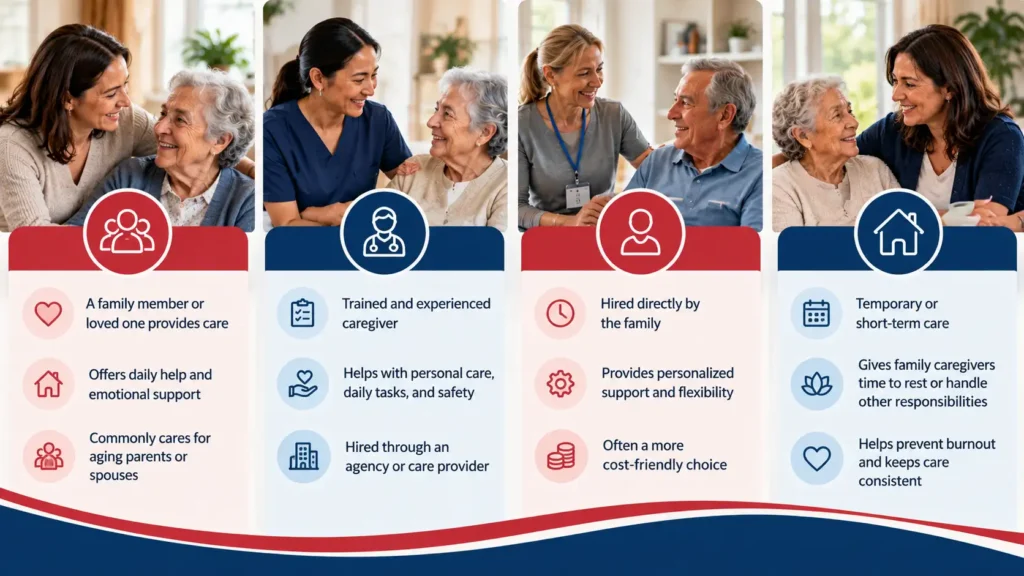
The Four Main Types Of Caregivers
Family Caregivers
Family caregivers are relatives or close family members who provide care without necessarily being paid as professional caregivers. A spouse, adult child, sibling, or other relative may take responsibility for helping an aging loved one at home.
Family caregiving often develops gradually. A family member may start by helping with groceries or transportation and later take on more responsibilities as care needs increase. This can make family caregiving feel manageable at first but more demanding over time.
Research has examined the strain associated with family caregiving for decades. Marjorie Cantor’s study, Strain Among Caregivers: A Study of Experience in the United States, was published in The Gerontologist in 1983 and examined the caregiving experience and strain among caregivers. Because this research is historical, it should be viewed as foundational rather than as current prevalence data.
This is also why families should not assume that being a family caregiver means handling every responsibility alone. Additional support can give a family member time to work, rest, manage personal responsibilities, or simply step away from caregiving for a while.
Professional Caregivers
Professional caregivers are paid individuals who provide care as part of a home care service or other professional arrangement. Depending on the provider and the person’s needs, support may include companionship, personal care, meal preparation, transportation, mobility assistance, and help with daily routines.
Training and qualifications vary by role, employer, state, and the type of care being provided. Families should confirm what training, experience, background screening, and supervision apply to a particular caregiver or provider.
Professional caregiving can provide a more structured arrangement when a family needs regular outside help. It may also allow family members to remain involved without having to provide every hour of care themselves.
Independent Caregivers
An independent caregiver is generally hired directly by the family rather than through a traditional home care agency. The caregiver and family agree directly on responsibilities, schedule, payment, and other terms.
This arrangement can give families more direct control over who provides care and how the schedule is organized. However, that control also means the family has more responsibility for screening the caregiver, checking references, confirming qualifications, discussing expectations, and planning for absences.
Families should also consider what happens if the caregiver becomes unavailable. A direct-hire arrangement may need a backup plan for illness, vacations, cancellations, or changes in care needs.
Respite Caregivers
Respite caregivers provide temporary support so a primary caregiver can take a break from caregiving responsibilities. The respite period might cover a few hours, a regular day each week, or another agreed schedule.
Respite care is particularly relevant when a family member provides most of the care but needs additional coverage. The goal is not necessarily to replace the primary caregiver. Instead, it provides temporary relief and helps create a more sustainable caregiving arrangement.
A 2026 mixed-methods systematic review of 33 studies found that respite care can provide benefits for caregivers, care recipients, and family functioning. The review also identified barriers such as limited resources, lack of flexibility and accessibility, insufficient knowledge, and negative attitudes toward respite care.
That finding is important because needing a break does not always mean a family wants to stop providing care. Sometimes the goal is simply to make the existing arrangement more manageable.

Comparing The Four Types Of Caregivers
The biggest differences between caregiver types involve who provides the care, how the arrangement is established, how long support is needed, and who manages the relationship.
| Caregiver Type | Who Provides Care | Typical Arrangement | Training | Duration | Primary Role |
| Family Caregiver | Relative or family member | Family-based | Varies | Ongoing or as needed | Provides care personally |
| Professional Caregiver | Paid care professional | Agency or professional service | Varies | Scheduled or ongoing | Provides regular outside support |
| Independent Caregiver | Directly hired caregiver | Private arrangement | Varies | Scheduled or ongoing | Provides care under a direct arrangement |
| Respite Caregiver | Temporary caregiver | Short-term arrangement | Varies | Temporary | Gives the primary caregiver time away |
Training And Qualifications
Family caregivers may have no formal caregiving training, while professional caregivers may have training or credentials related to the services they provide. Independent caregivers can have different levels of education and experience, so families should verify qualifications rather than assume them.
Respite caregivers can also come from different professional or private-care arrangements. The important factor is whether the caregiver has the experience needed for the person’s specific care needs.
Cost And Hiring Arrangements
Family caregiving is generally based on an unpaid family arrangement, although families may have other costs related to transportation, supplies, missed work, or outside support.
Professional and independent caregiving involve payment, but the way the family hires and pays the caregiver can differ. Professional services may handle staffing and administrative responsibilities, while direct hiring places more responsibility on the family.
Respite care can be arranged through a professional service or an independent caregiver, depending on availability and the family’s needs.
Short-Term Vs. Ongoing Care
Family, professional, and independent caregivers can all provide ongoing support. Respite caregiving is usually temporary and is designed around the needs of the primary caregiver and care recipient. However, respite support does not have to be a one-time arrangement. Some families use recurring respite care to create predictable breaks in an ongoing caregiving schedule.
Agency Vs. Direct Hiring
Working with an agency or matching service can reduce some of the work involved in finding a caregiver. Direct hiring gives the family a more direct relationship with the caregiver but also requires more involvement in screening and managing the arrangement. Before choosing either approach, families should understand who handles scheduling, payments, caregiver replacement, background checks, and communication if problems arise.
Schedule And Backup Coverage
A caregiver arrangement should account for more than the ideal schedule. Families also need to consider what happens when a caregiver is sick, unavailable, or no longer able to provide the required level of support. This is especially important when one caregiver handles most of the daily responsibilities. A backup plan can help prevent a sudden gap in care.

Other Caregiving Roles To Know
The four categories above are useful for understanding common care arrangements, but other terms appear in caregiving research and everyday conversations.
Informal Caregivers
Informal caregivers are generally people who provide care without being professional paid caregivers. Family members are a common example, although the exact use of the term can vary between studies and organizations. The terms family caregiver and informal caregiver can therefore overlap. They should not always be treated as completely separate categories.
Volunteer Caregivers
Volunteer caregivers provide support without receiving normal wages for the caregiving role. They may help through community organizations, nonprofit programs, faith-based groups, or other volunteer networks. The type and availability of volunteer support varies considerably by community, so it may supplement other caregiving rather than replace regular care.
Long-Distance Caregivers
Long-distance caregivers help someone who lives too far away for frequent in-person caregiving. Their role may involve arranging appointments, managing communication, coordinating services, handling paperwork, or checking that local support is in place. A long-distance caregiver may therefore also be a family caregiver. The term describes the caregiver’s circumstances rather than a separate professional category.
How To Choose The Right Type Of Caregiver
Choosing a caregiver starts with the person’s actual needs rather than the caregiver’s title. A family may need occasional companionship, daily personal care, regular supervision, or temporary relief from an existing caregiving arrangement.
Consider The Level Of Care Needed
Start by identifying what the person needs help with now. Consider personal care, mobility, meals, transportation, companionship, household routines, memory-related support, and supervision. It is also useful to consider whether those needs are likely to change. A caregiver arrangement that works for occasional assistance may not provide enough coverage if daily support becomes necessary.
Determine How Much Support Is Needed
Think about how many hours of support are needed and when that support is required. A few hours each week creates a different caregiving arrangement from daytime coverage, overnight help, or regular respite. Writing down the required schedule can make it easier to identify which caregiver arrangement fits the situation.
Consider Training And Experience
The caregiver’s experience should match the person’s needs. If someone requires help with dementia-related routines, mobility, personal care, or another specific concern, ask about relevant experience before agreeing to an arrangement. Families should also verify qualifications and screening information instead of relying only on a caregiver’s job title.
Decide Between Agency And Direct Hiring
Some families prefer the structure of working through a professional service. Others prefer to hire an independent caregiver directly. The decision should account for who will handle screening, scheduling, payments, replacements, and communication. A lower level of administrative support may require more involvement from the family.
Consider Compatibility With The Care Recipient
A caregiver may have the right experience but still not be a comfortable fit for the person receiving care.
Communication style, personality, routines, cultural preferences, interests, and comfort with the caregiver can all affect the experience. Families should give the care recipient an opportunity to participate in the decision whenever possible.
Plan For Schedule Changes And Backup Care
Care needs rarely stay exactly the same forever. A person may need more support after an illness, injury, mobility change, or progression of a condition.
Ask what happens if the regular caregiver cannot work. Having a backup plan before an urgent situation occurs can make changes much easier to manage.
When Should A Family Consider Additional Caregiving Support?
Families often consider additional support when the existing arrangement no longer provides enough coverage or when caregiving starts interfering with other important responsibilities. Signs that additional help may be useful include increasing supervision needs, difficulty managing personal care, frequent schedule conflicts, caregiver exhaustion, overnight needs, or changes that make the person’s daily routine harder to manage.
A family caregiver does not have to wait until the situation becomes overwhelming before seeking help. Additional support can supplement family involvement while allowing relatives to remain an important part of the person’s life. For families unsure whether outside help is needed, reviewing the specific care tasks, hours required, and challenges occurring at home can provide a clearer starting point.
Find The Right In-Home Caregiver For Your Family
If family caregiving is becoming difficult to manage alone, CareMatch at Home can help families find non-medical in-home care support. CareMatch at Home is a caregiver matching service, not a direct home care provider. Families describe their loved one’s needs, location, schedule, and preferences, and the service connects them with up to two vetted, background-checked caregivers or providers from its network. The matching service is free for families, while care arrangements, schedules, payments, and ongoing care are handled directly with the selected caregiver or provider.
Find In-Home Care With CareMatch at Home
Frequently Asked Questions
What Are The Four Main Types Of Caregivers?
The four types discussed in this guide are family caregivers, professional caregivers, independent caregivers, and respite caregivers. The categories describe common caregiving arrangements, but terminology can vary between organizations and research studies.
What Is The Difference Between A Family Caregiver And A Professional Caregiver?
A family caregiver is usually a relative or close family member who provides care as part of a family relationship. A professional caregiver is paid to provide care and may work through a professional service or another formal arrangement.
What Is An Independent Caregiver?
An independent caregiver is generally hired directly by the family rather than through a traditional home care agency. The family and caregiver typically discuss the schedule, responsibilities, payment, and other arrangements directly.
What Does A Respite Caregiver Do?
A respite caregiver provides temporary care so a primary caregiver can take a break or attend to other responsibilities. Respite support can be occasional or scheduled on a recurring basis.
What Is The Difference Between A Professional And Independent Caregiver?
Both can provide paid care, but the hiring arrangement differs. A professional caregiver may work through an agency or formal care service, while an independent caregiver is generally hired directly by the family.
Are Family Caregivers Considered Informal Caregivers?
Often, yes. Family caregivers are commonly considered informal caregivers because they provide care through a family or personal relationship rather than as paid professional caregivers. However, terminology varies between sources.
Can Someone Have More Than One Caregiver?
Yes. A person may have a family caregiver who coordinates care, a professional caregiver who provides regular assistance, and a respite caregiver who provides temporary coverage. Using multiple caregivers can help create a schedule that matches changing needs.
How Do I Choose The Right Caregiver For An Aging Loved One?
Start with the person’s care needs, required schedule, preferred arrangement, caregiver experience, and compatibility. Also consider screening, backup coverage, communication, and what happens if care needs change.